Four Shades of Spring in Chinese Green Teas
Spring is the season of first growth.
This May, we invite you to join a special 2h Chinese green tea tasting, where five teas reveal four shades of spring — from the sweet, brisk mung bean cake of Mengding Ganlu, to Biluochun’s delicate floral-fruity fragrance, Anji Baicha’s fresh, crystalline clarity, and Longjing’s gentle sweetness, reminiscent of warm toasted chestnut.
The teas in this tasting have been chosen not simply as well-known names, but as distinctive and carefully sourced expressions of some of China’s most celebrated spring green teas. Some come through Yiling’s own tea teachers, while others — such as the fully handmade Xihu Longjing from the core West Lake area — are especially rare teas that are not easily available beyond a small circle. Together, they reflect not only classic tea types, but also the people, places, and relationships behind them.
Spanning from the high mountains of Sichuan to the lake landscapes of Jiangnan, this tasting moves through some of China’s most celebrated green teas, tracing a journey from the southwest to the southeast. Through different leaf shapes, textures, and aromatic profiles, we experience how spring takes on different forms in the cup.
We will also taste two expressions of Longjing for a closer look at its delicate character, exploring how this iconic green tea is expressed both within and beyond the famed West Lake region.
Selection of the teas
While many of the teas were picked in the prized early spring window around Qingming, not all spring teas are meant to be harvested at the same moment. Some, like Anji Baicha, are at their best when the season is allowed to unfold a little further in the cooler mountain climate. What connects all five teas is not a single picking date, but the care behind their making — from hand-picking to traditional handcraft — and the clarity with which each tea expresses its origin, cultivar, and season.
To accompany the tasting, we will also serve a small selection of handmade tea snacks, prepared in-house to create a more complete and welcoming experience of spring tea.
🌱 🌱 🌱 🌱 🌱
🌱 Mengding Ganlu 四川手工蒙顶甘露
Grown in the high mountain tea gardens of Mt. Zhougong in Ya’an, this Mengding Ganlu comes from the wider Mengding mountain range, a region closely tied to some of the earliest tea cultivation traditions in China. Made from the native Old Chuan Cha small-leaf cultivar and harvested at around 1300–1500 metres, the tea develops in a cooler mountain environment where the buds emerge later and more slowly. This slower growth, together with the mist, altitude, and the biodiverse conditions of a tea garden set among glacial stones, gives the leaves a finer structure and a deeper, more quietly gathered freshness.
Only the most tender early spring buds are taken, just as they begin to open, and the tea is made entirely by hand in the traditional process of three rounds of stir-frying and three rounds of rolling. That demanding craftsmanship is part of what gives this Ganlu its distinctive identity: fresh and sweet, with a lively salivating quality, a soft green-bean-like depth, and a lingering returning sweetness after each sip.
🌱 Bi Luo Chun 太湖洞庭山碧螺春
This Biluochun comes from the slopes of Dongting East Mountain by Lake Tai (太湖), one of the most classic and historically celebrated growing areas for this type of tea. Here, tea bushes are traditionally cultivated among fruit trees in a mixed orchard landscape, where lake air, morning mist, and rich plant diversity create an especially favourable environment for the slow accumulation of aroma and inner substance in the leaf. The result is not simply fragrance, but a more integrated expression of place — one that gives Dongting Biluochun its unmistakable floral-fruity lift and finely textured freshness.
Only the youngest early spring buds are picked, at the precise moment when the first leaf has just begun to open. From hand-picking and repeated sorting to fixing, rolling, and drying, every step depends on speed, precision, and a high degree of manual skill. This tea is also shared by Yiling’s tea teacher,It takes immense care to produce even a small quantity of finished tea, which is part of why fine Biluochun feels so delicate yet complete. In the cup, it offers the classic character of the style – soft floral-fruity fragrance, downy tenderness, and a vivid spring brightness that feels both elegant and deeply rooted in Jiangnan.
🌱 Anji Baicha 高海拔安吉白茶
Grown in the high mountain tea gardens of Anji, Zhejiang, this tea is made from the celebrated Baiye No. 1 cultivar, known for its pale jade-white leaves and naturally high amino acid content. Here, perennial mountain mist, fertile gravelly soils rich in organic matter, and the natural temperature shifts between day and night create the conditions for slow, steady growth, giving the leaves a fuller structure and a more quietly layered freshness.
In the cooler mountain climate, the buds emerge later and are only harvested after Qingming. Rather than chasing the earliest possible picking date, this tea is shaped by patience: slower growth allows more depth to gather in the leaf, resulting in a cup that feels pure, gentle, and refined. This tea is shared by Yiling’s tea teacher, handcrafted and finished with low-temperature drying, it carries the calm clarity and soft floral freshness distinctive to high-mountain Anji Baicha.
🌱 Long Jing 西湖龙井&大佛龙井
Known for its flat leaf shape, gentle sweetness, and distinctive pan-fired style, Longjing will be explored here through two of the same cultivar (Longjing 43) — one from the core West Lake region in Hangzhou, and one from the high-elevation Yuezhou area in Xinchang.
Dafo Longjing
Harvested before Qingming from the high-elevation tea mountains of Yuezhou in Xinchang, this Dafo Longjing comes from a protected geographical indication area shaped by clean mountain air, lingering mist, and rich plant diversity. These quieter growing conditions allow the leaves to develop a more persistent fragrance and a broader, more layered structure, offering a compelling expression of Longjing beyond the familiar focus on West Lake alone.
Picked within a brief early spring window and traditionally made by skilled tea makers, it brings together the classic signatures of Longjing — floral lift, gentle chestnut warmth, and soft bean-like sweetness — while retaining the openness and depth of its mountain origin. This is also the Longjing shared by Yiling’s tea teacher, and part of why we wanted to include it here: not only as a strong example of high-quality Yuezhou Longjing, but as a tea with both place and personal connection behind it.
West Lake (Xihu) Longjing
Harvested before Qingming from the core production area around West Lake in Hangzhou, this Longjing 43 was made entirely by hand by the son of a well-known local master of hand-firing Longjing. Following traditional hand-firing methods passed down through generations, the tea is shaped through the full sequence of classical techniques and finishing stages that give West Lake Longjing its particular refinement and structure.
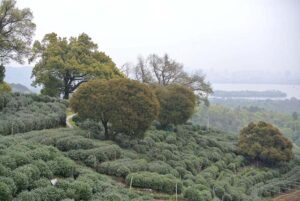
The tea garden itself lies in one of the most prized landscapes of the region, overlooking the lake, and producing even a small quantity of finished tea requires an extraordinary number of carefully picked tender buds. Teas of this kind are often reserved early in the season, and fully handmade Xihu Longjing from the core area rarely travels far beyond a small circle. We were fortunate to secure just a few brews to share this spring, so that alongside the mountain expression of Yuezhou Longjing, we can also experience the delicacy and beauty of a true handmade Xihu Longjing.
* Limited seats of 6